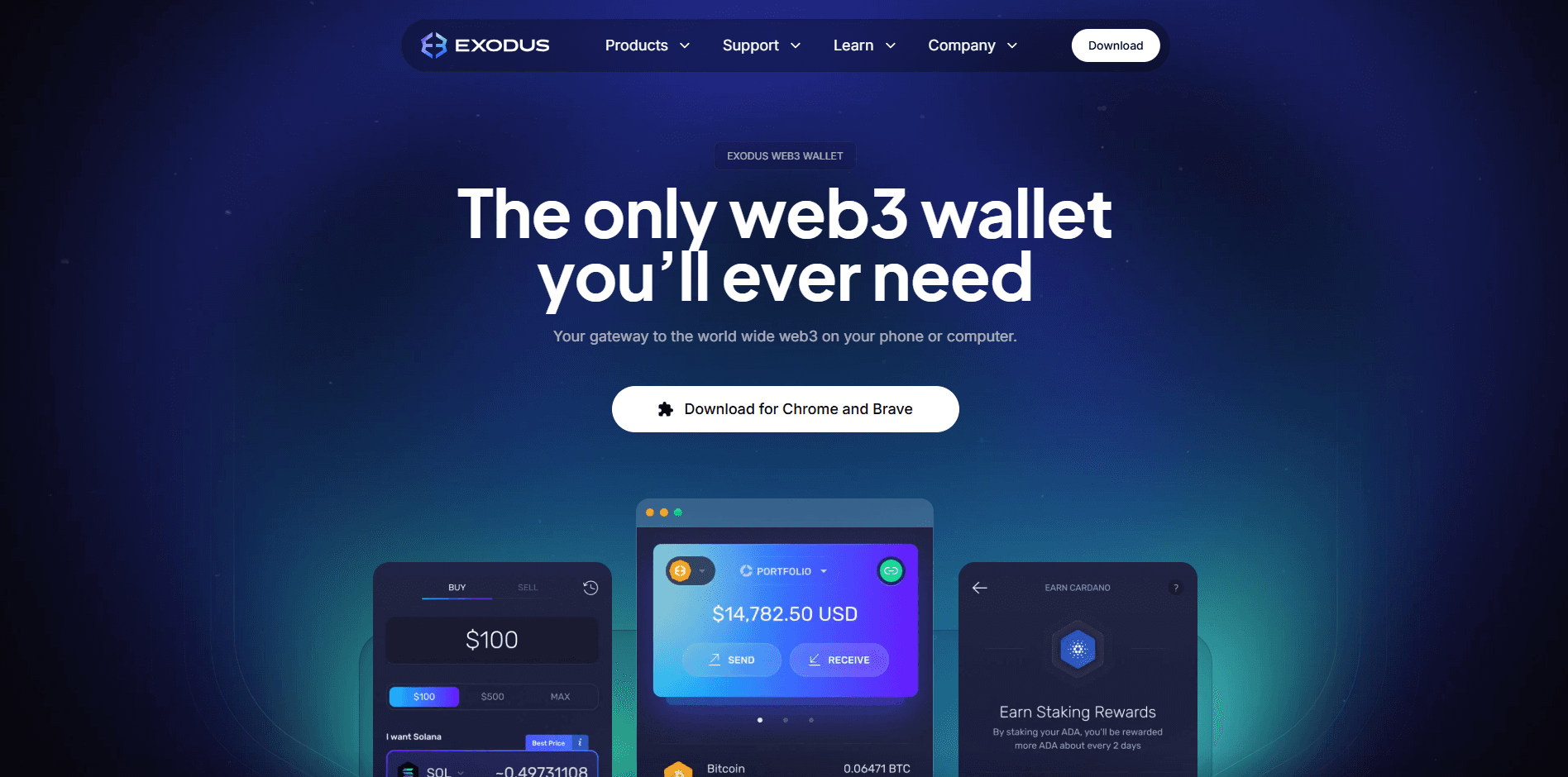
Navigating the New Frontier: The Ultimate Guide to Exodus Web3 Wallet
The transition from "buying crypto" to "living in Web3" can be daunting. If you are looking for a bridge between the simplicity of a mobile app and the power of decentralized finance (DeFi), the Exodus Web3 Wallet is designed specifically for you.
In this comprehensive guide, we explore how the Exodus browser extension unifies your digital life across Ethereum, Solana, and beyond, all while keeping you in total control of your private keys.
1. What is the Exodus Web3 Wallet?
Most users know Exodus as a beautiful desktop or mobile portfolio. The Web3 Wallet is their specialized browser extension (Chrome/Brave) that acts as your digital passport to the decentralized web.
Multi-Chain by Design: Unlike wallets that only support one network, Exodus connects to Ethereum, Solana, BSC, Polygon, and Cardano simultaneously.
Self-Custodial: You are the only one with access to your 12-word recovery phrase.
Integrated Swap: Move assets between chains without ever leaving your browser.
2. Setup Guide: From Installation to First Connection
Setting up a Web3 wallet is a high-stakes task. Follow these steps to ensure your foundation is secure.
Step 1: Secure Installation
Visit the official Exodus.com website.
Navigate to the "Web3 Wallet" section and click Add to Chrome/Brave.
Pin the Extension: Click the puzzle icon in your browser toolbar and pin Exodus for easy access.
Step 2: Create or Restore
Create New Wallet: This generates a fresh 12-word secret recovery phrase.
I Have a Wallet: You can import a phrase from MetaMask, Phantom, or your existing Exodus Mobile/Desktop app to sync your funds.
Step 3: The Security Layer
You will be prompted to create a Strong Password.
Note: This password only unlocks the extension on your current computer. It is not a backup for your funds. If you forget this password, you must use your 12-word phrase to regain access.
3. The 12-Word Secret Recovery Phrase (Safety First)
In the Web3 world, there is no "Forgot Password" email. Your 12-word phrase is the master key to your wealth.
The Do'sThe Don'tsWrite it on physical paper/metal.Never take a screenshot or photo.Store it in two separate, safe locations.Never type it into a "Support" website.Keep it offline at all times.Never save it in Google Drive or iCloud.
4. Key Features That Set Exodus Apart
🚀 Unified Multi-Chain Experience
The biggest pain point in Web3 is switching networks. In other wallets, you have to manually toggle between "Ethereum Mainnet" and "Solana." Exodus handles this in the background. If you visit a Solana dApp, Exodus speaks Solana; if you jump to Uniswap on Ethereum, it switches automatically.
🖼️ The NFT Gallery
Exodus isn't just for numbers; it's for art. The Web3 wallet features a built-in NFT gallery that supports multiple chains. You can view your collectibles, check their floor price, and send them to other wallets with a few clicks.
🔄 Cross-Chain Swaps
Need to turn your Ethereum into Solana to buy an NFT? Exodus includes a built-in swap engine that aggregates rates from multiple providers, ensuring you get the best price without needing to send funds to a centralized exchange (CEX).
5. Connecting to dApps: Your First Steps into DeFi
Once your wallet is funded, you can interact with decentralized applications (dApps).
Visit a Site: Go to a platform like Uniswap (DeFi) or OpenSea (NFTs).
Connect Wallet: Click "Connect." If Exodus isn't listed, choose "MetaMask"—Exodus has a "prioritize" feature that allows it to mimic MetaMask to ensure compatibility with every site.
Approve Permissions: Always read the pop-up. The site will ask to "View your balance" and "Request signature for transactions."
6. Advanced Security: Connecting Hardware Wallets
For those managing a significant portfolio, software (hot) wallets have inherent risks because your keys are technically on an internet-connected device.
Exodus allows you to pair with Trezor (Desktop) or Ledger (Mobile/Extension).
By linking a hardware wallet, you get the best of both worlds: the stunning Exodus user interface and the "cold" security of a physical device that requires a button press to authorize any movement of funds.
7. Troubleshooting & FAQ
Why can't I see my tokens? Ensure the network for that token is enabled in the "Assets" settings.
"Insufficient Funds for Gas": Every transaction requires a small fee paid in the network's native coin (e.g., ETH for Ethereum, SOL for Solana). You must keep a small amount of the native coin in your wallet to move other tokens.
Can I use Exodus on multiple computers? Yes. Simply install the extension on a second computer and select "I Have a Wallet" using your 12-word recovery phrase.
Conclusion: Taking Control of Your Digital Future
The Exodus Web3 Wallet is more than just a place to store Bitcoin; it is a tool for the next generation of the internet. By removing the technical hurdles of multi-chain management and providing a world-class UI, Exodus makes the decentralized world accessible to everyone.